



Worms can live in the human body for a long time without showing any signs of their presence.The main symptoms of parasitic infection appear much later and often resemble the symptoms of other diseases.A person can search for the cause of his illness for a long time and be treated for a completely different disease, although the solution to the problem lies in the worm infection.
Typically, parasites are suspected in the later stages, when treatment for other diseases does not help.At this time, the worms in the body reach maturity and their removal becomes more difficult.It is important to be able to recognize the symptoms as soon as they appear and immediately make a diagnosis to find out if a parasitic infection is to blame for frequent allergic rashes and other unpleasant ailments.
What types of worms can a person have?
Worms is a common name for a number of parasites.There are about a hundred of them in total, of which there is a small group of more common representatives, which should be discussed separately.
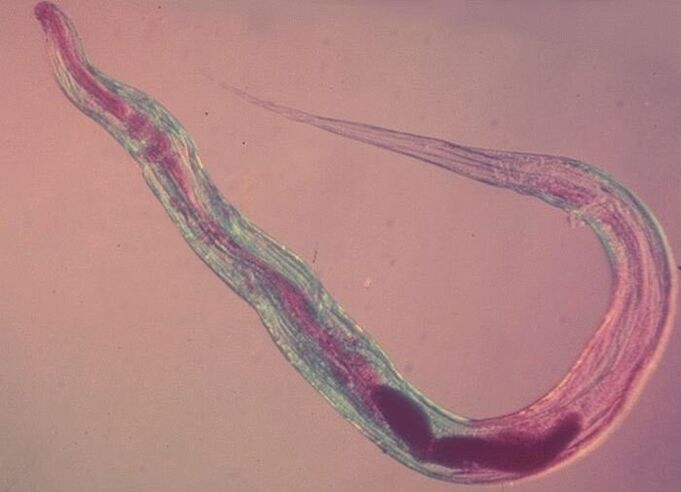
Red worms
Worms are the most common type of helminthic infection affecting adults and children.Their presence is more easily determined.This type of worm lays eggs in the skin between the buttocks.Therefore, an itch is often enough to determine the presence of worms.
Roundworms
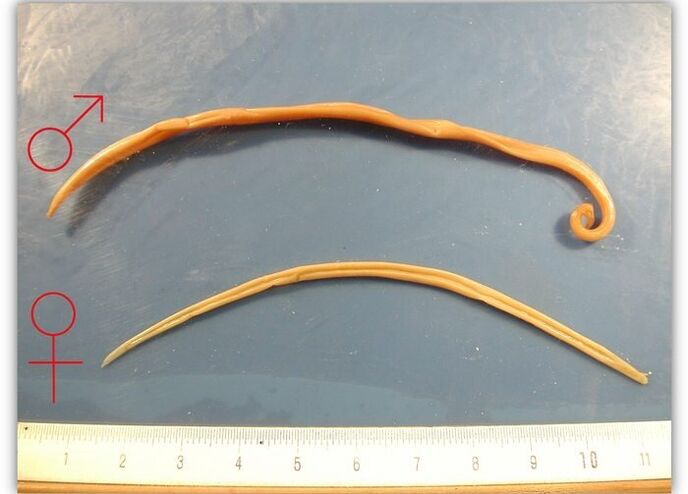
The "target" of roundworms is the respiratory tract.With ascariasis, copious sputum is produced during coughing.If you take it for analysis, you can find traces of parasitic infection in it.An increase in body temperature is also possible.
Trichinella
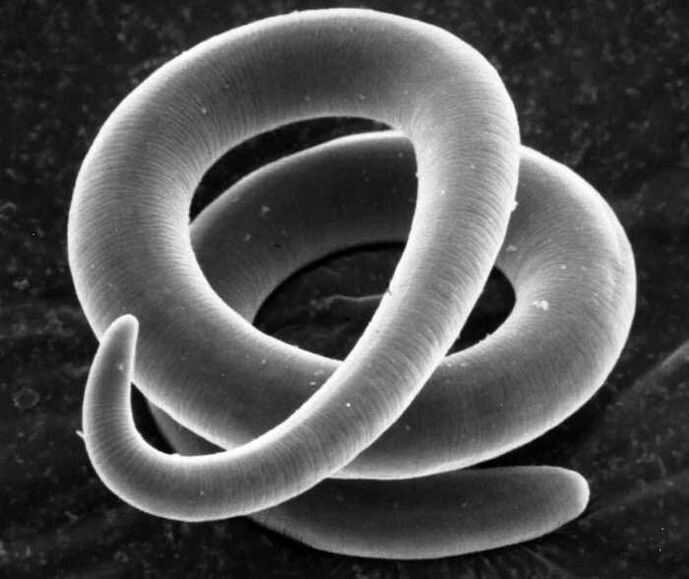
These parasites are the most difficult to detect - they stick to the intestinal wall and do not come out like tapeworms.Trichinosis has the highest mortality rate among all types of helminthic infections - it is a serious disease that is difficult to treat.With the flow of lymph, Trichinella capsules can spread throughout the body.
The symptoms of this lesion are more reminiscent of typhoid fever.
Trematodes
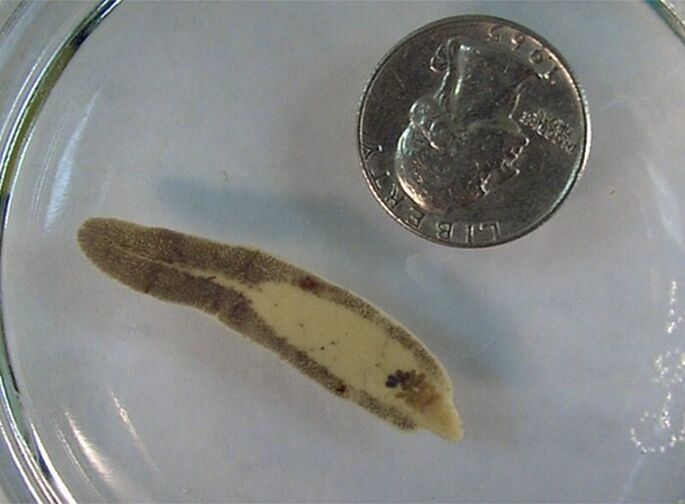
Trematodes are flatworms that attack the liver, lungs and blood.Infection usually occurs from exposure to contaminated water or eating undercooked meat.
There are other types of worms, but they are not as dangerous or widespread.The main symptoms and treatment of all helminthic infections are similar.
Symptoms
Symptoms of helminth infection are different.If most of them are present, it is worth thinking about a possible parasitic infection and making a diagnosis.
- Bloating, increased gas formation, any other problems with the functioning of the large intestine.
- Frequent constipation or diarrhea.It depends on the stage of development of the parasites.Constipation occurs when the worms become large and block the intestinal passage with clots.Diarrhea indicates that tall individuals interfere with bile secretion.
- Allergic reactions.Especially noticeable if a person is not allergic.Allergies can appear in different forms - rashes, eczema, the appearance of boils and papillomas.
- Cough.Often dry, without other cold symptoms.Cough suppressants and antibiotics do not solve the problem.
- Inflammatory diseases of the respiratory system.Worms can migrate throughout the body and reach the respiratory tract.This can provoke bronchitis, pneumonia and asthma.
- Itching in the anal area.It is accompanied by the release of parasites for laying eggs.It appears mainly at night.
- Joint and muscle pain.They also appear due to the movement of parasites throughout the body.
- Teeth grinding - bruxism.It is associated with increased activity of the nervous system during parasitic infection.Appears during sleep.
- Chronic fatigue and depression-like conditions.The waste products of worms literally poison the body, which leads to a deterioration in the general well-being of a person.
- All manifestations of reduced immunity, frequent colds.There may be difficulty with rapid healing of wounds.
If most of these symptoms are observed, there is a high probability of infection with worms.It is best to immediately perform a series of diagnostic tests to confirm or refute this assumption.
Important!If you have any of these symptoms, you should immediately consult a specialist.These signs can indicate not only a helminthic infection, but also other serious diseases.
Diagnosing
When infected with worms, the diagnosis cannot be made by the presence of symptoms alone.A number of studies need to be carried out.Some of them give almost one hundred percent accurate results.
- Various microscopic examinations of feces and scrapings.These methods are the cheapest and most common, but they do not give a 100% reliable result.Worms can be recognized using these tests only at the time of egg laying, otherwise their presence will be invisible.
- ELISA – enzyme-linked immunosorbent assay.This method gives an extremely accurate result and helps to determine the stage of development of the worms and their type.The only disadvantage of this analysis is the rather high price of its implementation.
- Hemoscan.This method can help disprove or confirm the presence of worms in the body.With this blood test, traces of their vital activity and intoxication will be visible.The essence of this method is the study of "live" blood that has just been taken.

Important!It is usually recommended to undergo several studies to confirm the result.
Which doctor treats you?
If you suspect a helminthic infection, it is best to contact your regular therapist and describe the situation to him.If the tests to determine the presence of parasites have already been carried out independently, you should take them with you.
The therapist will refer you to a doctor who is most suitable for your particular situation.If the worms are concentrated in the gastrointestinal tract, the specialist will send a referral to a gastroenterologist.This happens in most cases, since most of the parasites live in the intestines.

In some cases, consultation with a parasitologist or specialist in parasitic diseases is required.But such highly specialized doctors are not available everywhere, so situations that do not go beyond a typical infection are completely under the control of the attending physician.
Therapy at home
Immediately after the identification of the disease, treatment should be started.Most anthelmintic drugs have many side effects, so it is recommended to take them under the supervision of your doctor.
Medicines vary depending on the type of worm that infects the body.In general, all medications can be divided into several groups.
- Medications for nematodes, which include pinworms and roundworms.
- Remedies for cestodes - tapeworms, which include bovine tapeworm, small tapeworm, echinococcus.
- Medicines for trematodes, flatworms.
Important!It should be remembered that anthelmintic drugs are very toxic and should be taken with caution.
Taking medications for prevention
Since taking anthelmintic medications has a large number of negative effects, it is not recommended to take them as such, for prevention purposes, unless there is an increased risk of infection.Infection can happen every day: if you take a pill today, you can get sick tomorrow.
There is a small list of indications for the prophylactic use of anti-worm drugs:
- The appearance of worms in a family member or person living in the same apartment.Someone can infect others, therefore, if helminths are detected in one of the family members, everyone else is recommended to take prophylactic anthelmintic drugs.
- If a child goes to kindergarten, then he, his parents, brothers or sisters are also advised to take anthelmintic drugs for preventive purposes.It is believed that in a closed group of children there is an increased risk of the spread of parasites.
- Domestic animals.If there are cats or dogs in the house, especially if they often go outside, the owners are recommended to do prophylaxis with antiparasitic drugs.
- Contact the ground, working with it.This is especially true for summer residents and wildlife enthusiasts.
- Constant travel to exotic countries.There is a high probability of bringing a rare parasite from southern countries, then the treatment will be complicated by the inability to quickly determine its variety.
- Hobbies related to being in nature.These include hiking, fishing, hunting.

Only in these cases, the prophylactic use of anthelmintic drugs is permissible and will be useful.
Treatment with folk remedies
Often, folk antiparasitic drugs come to the aid of deworming tablets.You have to be careful with them - some of them are dangerous or can cause harm if abused.
Colon cleansing
Sometimes it is recommended to cleanse the intestines with enemas after taking anthelmintics to literally wash away the dying parasites.The rationality of this method is debatable, but a regular water enema is not dangerous - it can be done for your peace of mind.
Some recommend doing an enema with soda or salt - this method is even more dubious.Soda and salt can cause burns on the mucous membrane and disrupt the water balance, so you should not use it.In addition, most parasites live in another part of the intestine.This method should be reserved as a last resort.

Treatment with garlic
Worms are known to fear spicy and spicy foods.Therefore, during treatment, you can introduce more garlic into the diet as a spice.You can also eat a few cloves in the morning with a glass of milk.Then you need to empty your bowels and eat breakfast.You can do it without milk - this product just makes it easier to take garlic.
Inserting tampons soaked in garlic juice into the anus is not recommended.It can cause allergies and burns.

pumpkin seeds
Pumpkin seeds are another effective folk remedy for the treatment and prevention of parasitic diseases.There are several ways to take them to fight worms.
Every morning on an empty stomach you should eat a few spoons of pumpkin seeds.Then, you should wait about an hour and empty your bowels.If this cannot be done, you should take a laxative.Then you can have breakfast.

For the second method, you need to mix a glass of ground roasted pumpkin seeds with a glass of honey and a spoonful of soda.Leave this mixture for about ten days in a dark place.Use only glass containers.The prepared mixture should be eaten one spoon every morning long before the meal.
Important!If you are allergic to folk remedies, you should avoid them.
Preventing
The main prevention of parasitic diseases is keeping the body and home clean.After using the toilet, when you come from outside, you must wash your hands thoroughly with soap.You cannot share towels, toothbrushes or combs with other people, even if they are family members.
Meat and fish should be washed before cooking and cooked thoroughly.Wash fruits and vegetables well, preferably in boiling water, before eating.

It is not worth taking anthelmintic drugs for prevention, but periodically you can rely more on spicy foods and garlic.For the same purpose, you can include pumpkin seeds in your diet.
Knowing about all the possible symptoms and manifestations of parasitic diseases, they can be identified at an early stage and then treated quickly and painlessly.